
Amazon PPC Keyword Ranking: How to Track Whether Your Ads Are Actually Working
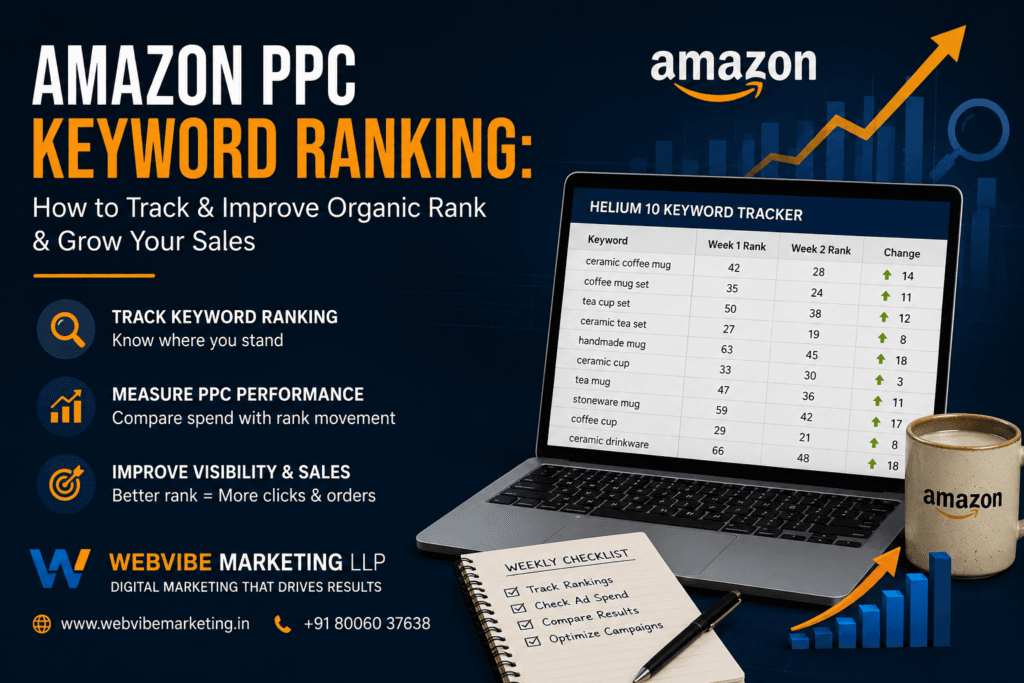
Amazon PPC Keyword Ranking: How to Track Whether Your Ads Are Actually Working
Amazon PPC keyword ranking
Running Amazon PPC campaigns without monitoring keyword ranking is like spending money on advertising without checking whether your business is becoming more visible.
Many Amazon sellers focus heavily on metrics such as ACOS, ROAS, clicks, impressions, and conversions. These metrics are important, but they do not tell the entire story.
One of the most useful signals to monitor alongside PPC performance is keyword ranking movement.
When your product starts ranking better organically for important converting keywords, your PPC campaigns may be contributing to stronger visibility and potentially more organic sales. On the other hand, if you are consistently spending on a keyword while your organic ranking remains stagnant or declines, it may be time to review your campaign structure, keyword targeting, bids, listing relevance, or conversion performance.
In this guide, Webvibe Marketing LLP explains how Amazon sellers can create a simple weekly keyword-ranking tracking system and use it alongside PPC data to make better advertising decisions.
Why Amazon Sellers Should Track Keyword Rankings
Amazon advertising is not only about generating immediate paid sales.
A well-structured PPC campaign can also help increase product visibility for relevant search terms. When customers repeatedly see, click, and purchase a product for a particular search query, the product can potentially become more competitive for that keyword organically.
This is why sellers should look beyond individual PPC metrics.
For example:
Keyword: Ceramic Coffee Mug
Week 1 Organic Rank: 48
Week 2 Organic Rank: 37
Week 3 Organic Rank: 29
This movement indicates that the product is gaining visibility for the keyword.
However, ranking should never be evaluated in isolation. Amazon rankings can fluctuate because of competition, sales velocity, pricing, inventory, relevance, customer behavior, seasonality, and other marketplace factors.
The objective is to identify meaningful ranking trends over time.
The Problem: Sellers Often Run PPC Campaigns Without Tracking Rank
A common Amazon PPC mistake is focusing only on the advertising dashboard.
A seller may see:
- High impressions
- Good clicks
- Several conversions
- Acceptable ACOS
- Strong ROAS
But an important question may remain unanswered:
Is the product becoming more visible organically for the keywords that are actually generating sales?
Without tracking keyword positions over time, it becomes difficult to understand the broader impact of your advertising strategy.
This does not mean that keyword ranking is the only measure of PPC success.
Instead, ranking movement should be used as an additional performance indicator alongside sales, conversion rate, ACOS, ROAS, CPC, impressions, clicks, and organic sales.
What Is Amazon Keyword Ranking?
Amazon keyword ranking refers to the position of a product in Amazon’s search results for a particular search term.
For example, suppose a customer searches for:
“ceramic tea set”
If your product appears near the top of the organic search results, it has a stronger organic position for that keyword than a product appearing much further down the results.
Ranking position can change regularly.
A product may move:
#60 → #45 → #31 → #18
or:
#20 → #28 → #36
Tracking these movements can help sellers identify whether their visibility for important keywords is improving, declining, or remaining relatively stable.
PPC Performance vs. Keyword Ranking
Amazon PPC performance should be evaluated using multiple metrics.
Important PPC Metrics
Some of the most important metrics include:
- Impressions
- Clicks
- Click-through rate
- CPC
- Orders
- Conversion rate
- Advertising cost of sales (ACOS)
- Return on ad spend (ROAS)
- Advertising sales
- Total sales
- Organic sales
Keyword ranking adds another useful layer of analysis.
For example:
| Keyword | PPC Spend | Orders | Organic Rank Change |
|---|---|---|---|
| Ceramic Mug | ₹1,500 | 24 | #42 → #25 |
| Coffee Mug | ₹1,200 | 18 | #31 → #28 |
| Tea Cup Set | ₹1,000 | 14 | #55 → #56 |
The first keyword shows a positive ranking trend, while the third keyword has remained almost unchanged.
This does not automatically mean the third campaign is failing. It means the seller should investigate why the keyword is not showing the desired organic movement.
How to Track Your Top 10 Amazon Keywords
A simple tracking system can be created in just a few steps.
Step 1: Identify Your Top Converting Keywords
Start by identifying the keywords that are most valuable to your business.
Look for search terms that generate:
- Consistent orders
- Strong conversion rates
- Relevant traffic
- Profitable sales
- Meaningful advertising revenue
Instead of tracking hundreds of keywords initially, start with your top 10 converting keywords.
This makes the process easier to manage and allows you to focus on keywords that have the greatest commercial importance.
Step 2: Add Your Keywords to a Tracking Tool
Tools such as Helium 10 Keyword Tracker can help sellers monitor keyword positions over time.
You can also use relevant data available through Amazon Brand Analytics, where eligible brand owners can access search and customer behavior insights.
The goal is to establish a baseline.
Record the current position of your selected keywords before making significant changes to your PPC strategy.
For example:
| Keyword | Starting Rank |
|---|---|
| Ceramic Coffee Mug | 42 |
| Ceramic Tea Cup | 35 |
| Coffee Mug Set | 51 |
| Tea Set | 27 |
| Handmade Ceramic Mug | 64 |
This becomes your starting point for future comparisons.
Step 3: Create a Weekly Ranking Spreadsheet
You do not need a complicated analytics system.
A simple spreadsheet is enough.
Use columns such as:
| Keyword | Week 1 Rank | Week 2 Rank | Change |
|---|---|---|---|
| Ceramic Coffee Mug | 42 | 35 | +7 |
| Ceramic Tea Cup | 35 | 29 | +6 |
| Coffee Mug Set | 51 | 54 | -3 |
| Tea Set | 27 | 21 | +6 |
Here, a positive movement means the product moved closer to the top of Amazon’s search results.
For example:
Rank 42 → Rank 35 = improvement
while:
Rank 35 → Rank 44 = decline
Keeping the same tracking format every week makes trends easier to identify.
Step 4: Compare Ranking Movement With PPC Spend
This is where the tracking system becomes particularly useful.
Record your weekly advertising spend for the same keywords.
For example:
| Keyword | Weekly PPC Spend | Rank Week 1 | Rank Week 4 | Trend |
|---|---|---|---|---|
| Ceramic Mug | ₹2,000 | 48 | 29 | Improving |
| Tea Cup | ₹1,500 | 35 | 31 | Slight Improvement |
| Coffee Set | ₹1,800 | 42 | 44 | Declining |
| Ceramic Bowl | ₹900 | 60 | 45 | Improving |
Now you can investigate the relationship between advertising activity and keyword performance.
If a keyword receives meaningful PPC spend and generates conversions while organic ranking improves over several weeks, that may indicate a positive overall trend.
If another keyword receives substantial spend but generates weak conversion and shows no meaningful ranking improvement, it may deserve closer examination.
Why Conversions Matter More Than Clicks
Getting clicks is not enough.
Amazon sellers ultimately need customers to purchase.
Imagine two keywords:
Keyword A
- 500 clicks
- 30 orders
- Strong conversion rate
- Improving organic ranking
Keyword B
- 500 clicks
- 3 orders
- Weak conversion rate
- Flat organic ranking
Although both keywords generated the same number of clicks, their business value is very different.
This is why sellers should evaluate clicks, conversions, sales, profitability, and ranking trends together.
What If Your Keyword Ranking Is Not Improving?
If you are spending consistently on a keyword but your ranking remains stagnant, do not immediately assume that PPC is useless.
There can be multiple reasons.
1. Your Listing May Need Improvement
Your product listing plays an important role in converting traffic.
Review:
- Product title
- Bullet points
- Product description
- Images
- A+ Content
- Backend search terms
- Pricing
- Reviews
- Product positioning
If customers click your advertisement but do not purchase, the problem may be related to the listing or offer rather than simply the PPC campaign.
2. Your Keyword May Not Be Highly Relevant
Not every high-volume keyword is necessarily valuable.
A keyword can generate significant traffic but still produce poor results if the search intent does not match your product.
For example, a seller selling a premium ceramic tea set should focus on highly relevant searches instead of chasing every broad keyword related to cups, mugs, or kitchen products.
Relevance is critical.
3. Your Bid Strategy May Need Review
Your PPC campaign structure and bidding strategy can affect visibility and traffic.
Depending on your objectives, you may need to review:
- Keyword bids
- Placement adjustments
- Match types
- Campaign segmentation
- Search term performance
- Negative keywords
- Budget allocation
Do not increase bids blindly.
The goal should be to allocate budget toward keywords that demonstrate meaningful commercial potential.
4. Your Competition May Be Stronger
Amazon is a competitive marketplace.
Even if your product is receiving sales, competitors may be generating significantly more sales velocity for the same keyword.
A ranking decline does not necessarily mean your campaign suddenly stopped working.
It could indicate that competitors have:
- Increased advertising activity
- Improved conversion rates
- Lowered prices
- Added promotions
- Improved listings
- Gained more reviews
- Increased sales velocity
Therefore, keyword ranking should always be interpreted in context.
5. Inventory Problems Can Affect Performance
Running out of stock can seriously disrupt momentum.
If your product becomes unavailable, you may lose sales opportunities and search visibility.
Before aggressively optimizing PPC, make sure inventory levels are healthy enough to support the advertising strategy.
Don’t Judge PPC From One Week of Data
One of the biggest mistakes sellers make is making major decisions based on short-term fluctuations.
Amazon keyword rankings can move up and down.
Instead of asking:
“Did my rank improve this week?”
ask:
“What is the ranking trend over the last 4–8 weeks?”
A longer observation period can provide a more useful picture.
For example:
Week 1: #62
Week 2: #55
Week 3: #49
Week 4: #43
Week 5: #39
Week 6: #35
This is much more meaningful than a single week’s movement.
Build a Weekly Amazon PPC Performance Routine
A simple weekly routine can make keyword tracking much easier.
Every Sunday:
1. Export or record keyword rankings
Check your top 10 keywords.
2. Record PPC spend
Note how much was spent on those keywords.
3. Record conversions
Track orders and sales generated.
4. Compare ranking movement
Identify keywords that improved, declined, or remained stable.
5. Investigate major changes
Look for keywords showing unusual movement.
6. Optimize carefully
Adjust campaigns based on data rather than assumptions.
This process can become a repeatable part of your Amazon PPC management strategy.
A Simple Amazon Keyword Tracking Template
You can create a spreadsheet with the following columns:
| Keyword | Week 1 | Week 2 | Week 3 | Week 4 | PPC Spend | Orders | Trend | Action |
|---|---|---|---|---|---|---|---|---|
| Keyword 1 | 45 | 39 | 34 | 29 | ₹2,000 | 25 | Improving | Scale |
| Keyword 2 | 28 | 30 | 31 | 34 | ₹1,800 | 12 | Declining | Review |
| Keyword 3 | 61 | 57 | 53 | 48 | ₹1,100 | 15 | Improving | Monitor |
| Keyword 4 | 22 | 23 | 22 | 24 | ₹1,500 | 18 | Stable | Test |
This gives you a simple weekly snapshot of your advertising and organic visibility.
Important: Ranking Is a Signal, Not the Entire Answer
Keyword ranking can be a valuable performance indicator, but it should not be treated as the only measure of PPC success.
A successful Amazon advertising strategy should consider the complete picture:
PPC + Conversion Rate + Sales + Profitability + Organic Visibility + Customer Demand
For example, a keyword may improve in ranking but still produce unprofitable sales.
Conversely, a highly profitable keyword may not experience dramatic ranking improvement but could still be valuable for your business.
The right approach is to combine ranking data with financial and advertising performance.
How Webvibe Marketing LLP Can Help With Amazon PPC
Managing Amazon PPC effectively requires more than simply launching campaigns and increasing bids.
At Webvibe Marketing LLP, we focus on data-driven digital marketing strategies designed to help businesses improve their online visibility and advertising performance.
For Amazon sellers, a structured PPC approach can include:
- Keyword research
- Competitor analysis
- Amazon PPC campaign setup
- Sponsored Products strategy
- Sponsored Brands strategy
- Sponsored Display strategy
- Keyword bid optimization
- Search-term analysis
- Negative keyword optimization
- Campaign structure improvement
- Listing and conversion analysis
- Performance reporting
- Amazon SEO strategy
- Organic keyword monitoring
The objective is simple:
Spend smarter. Understand the data. Improve visibility. Build sustainable growth.
Quick Action Plan for Amazon Sellers
If you are currently running Amazon PPC campaigns, start today.
Your 30-Minute Action Plan
Step 1: Open your keyword tracking tool.
Step 2: Identify your top 10 converting keywords.
Step 3: Record their current organic rankings.
Step 4: Create a simple weekly tracking spreadsheet.
Step 5: Record PPC spend and orders for each keyword.
Step 6: Set a weekly review every Sunday.
Step 7: After 4–8 weeks, analyze the ranking trends.
This small process can give you a much clearer view of how your Amazon advertising strategy is performing.
Final Thoughts
Amazon PPC should not be treated simply as a system for buying clicks.
The bigger objective is to generate profitable sales while improving your product’s visibility and competitiveness in the marketplace.
By tracking your most important keywords every week and comparing organic ranking movement with PPC spend, conversions, and sales, you can make more informed decisions about your advertising strategy.
Do not run Amazon PPC blindly.
Track the keywords that matter. Measure the movement. Analyze the data. Optimize based on evidence.
If you need professional support with Amazon PPC management, Amazon SEO, keyword research, listing optimization, or digital marketing, Webvibe Marketing LLP can help you build a structured strategy focused on measurable growth.
Ready to Improve Your Amazon Advertising Strategy?
Contact Webvibe Marketing LLP
📞 +91 80060 37636
🌐 www.webvibemarketing.in
Webvibe Marketing LLP — Data-Driven Digital Marketing for Business Growth.
Need Help Growing Your Marketplace Business?
Talk to Webvibe Marketing LLP for marketplace management, listing SEO and advertising support.
Talk on WhatsApp →